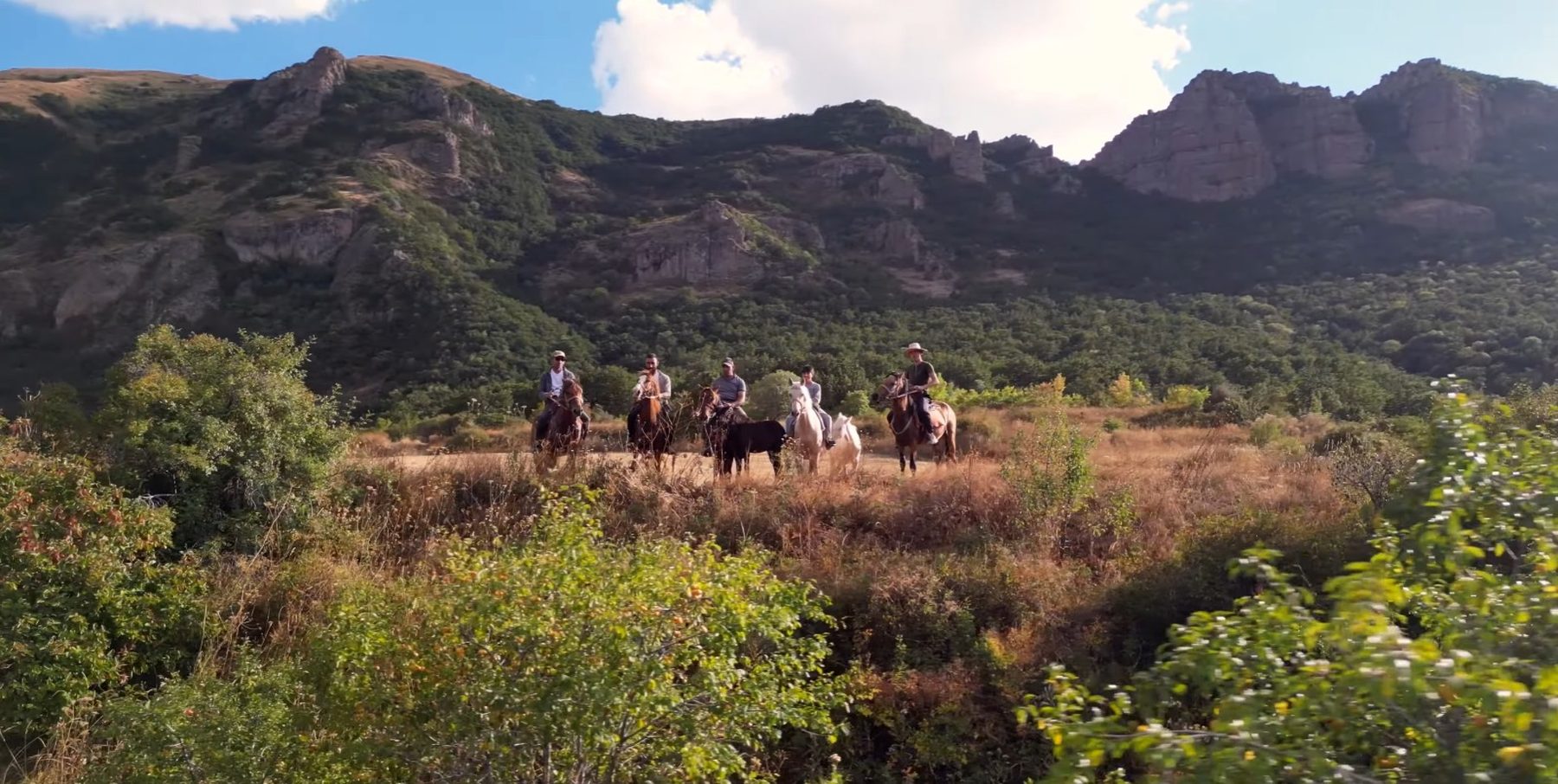
The riders set off on a mountain trail and return about three hours later. All that time the village celebrates: a harvest market, a village table, dancing, sporting demonstrations, horse rides. The day peaks with the leaders crossing the finish and the awards.
The programme is more than the race. Guests take a jeep tour up to the lake and walk to the medieval stone bridge over the stream running through the village.
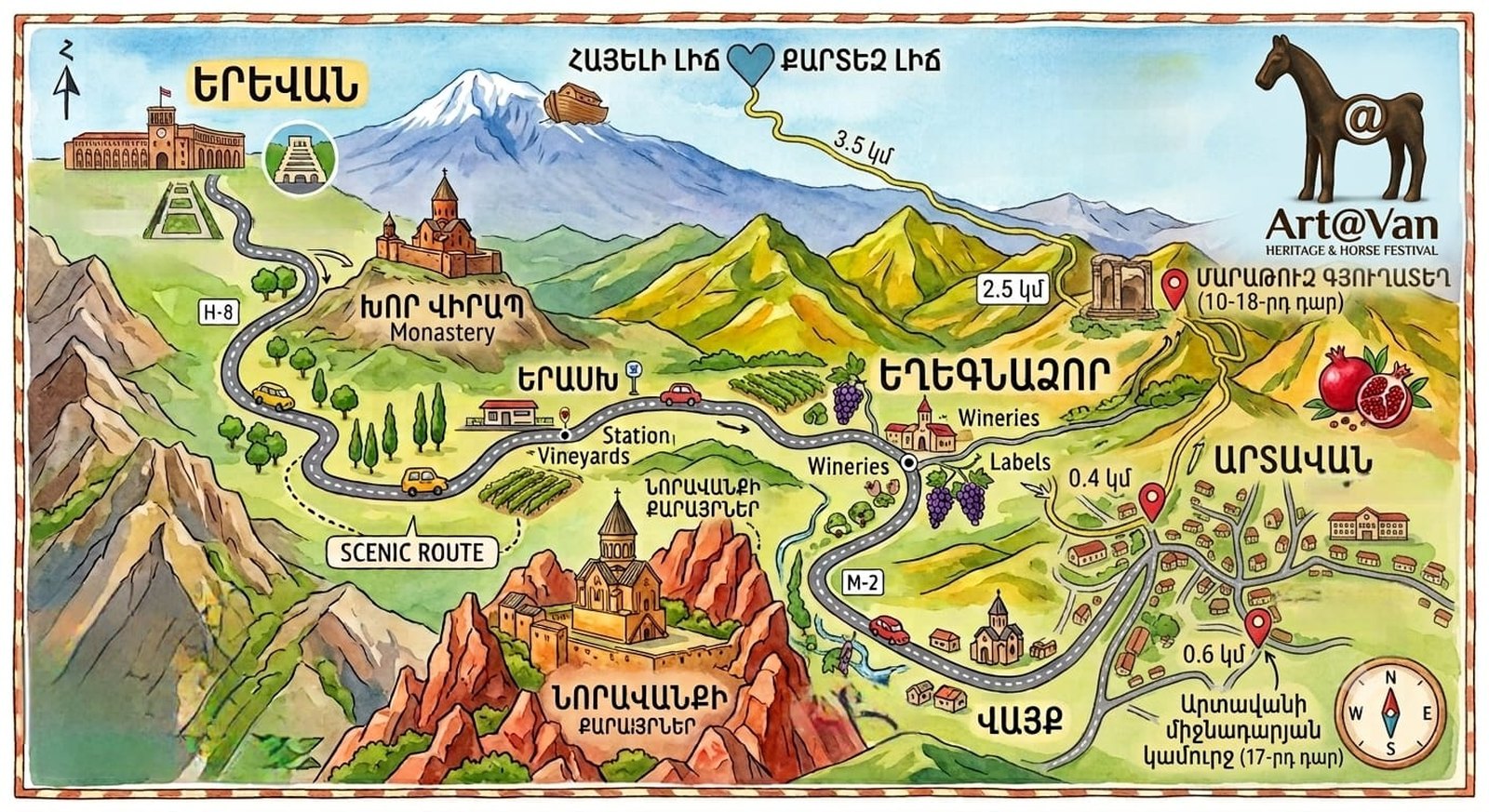
By the Sasuntsi David monument, Artsakh Avenue. Tour operators pick their own departure point
130–140 km along the Yerevan — Meghri highway, 2–2.5 hours
Welcome with mountain herbal tea — thyme, rosehip
A market by the schoolchildren and their parents, a hay-bale lounge, a village table: cheese, matsun, aveluk, dried fruit
Behind the school. The riders are out on the trail for about three hours
A kyokushin karate demonstration, ensembles from the Vayk community, national dancing, horse rides
The leaders return; certificates and prizes for the first three places
Announcements from the organisers — programme, meeting time, weather, changes on the day. Participants also arrange carpooling there.
Join the chat130–140 km along the Yerevan — Meghri highway, 2–2.5 hours. The last stretch is a dirt road; in rain you need ground clearance.
Open in mapsThe event, the route, the programme and the history of the village in a single file to keep or forward.
Download PDFArtavan, Vayots Dzor. 39.6644, 45.6164. The market and the finish are on the field by the school.
Show on the mapThe village is much older than its name: in the 13th century it was called Hajoghk and paid tribute to Tatev Monastery, and it took its present name only in 1950.
The medieval arched bridge over the stream. The programme includes a walk to it.
Fragments of an 11th–12th-century church and ancient khachkars. Stones of the demolished church sit in the walls of the club and school.
The bell from Akhach still rings the start and end of lessons. The race starts and finishes behind the school.
The Art@Van emblem follows bronze horse figurines of the 9th–5th centuries BC from Ayrum and Paravakar in Tavush, now kept in the History Museum of Armenia.
The Ayrum horse, 6th–5th century BC, stands with a close-cropped mane, long neck, defined muscles and natural proportions. It shows how strong the local breed was.
The horse was linked with the Sun and the cosmic order. Horses were sacrificed to the gods of war and the sun, and bronze likenesses were worn as amulets or offered to temples.
This was the name of the Armenian cavalry in antiquity and the Middle Ages, one of the strongest forces in the Near East.
The rider wore scale or mail armour from neck to feet, a helmet and often a metal mask. The horse was covered in armour on a leather base over chest, forehead and flanks. The main weapon, the kontos, was a heavy lance 400–450 cm long.
They formed up tightly, in a wedge or a wall, and struck the infantry at a slow but unstoppable pace. No shield wall held against armoured horses. Once the line broke, the light cavalry went in.
In Armenian mythology the horse is no ordinary animal but a sacred being tied to fire, water and the sun. The best horses are born from the sea.
In the epic Daredevils of Sasun, Kurkik Jalali is not merely the horse of Sanasar, Mher and David but the clan’s protector. Sanasar raises him from the sea floor. He speaks with a human voice, knows the future and warns his master of danger.
On 11 October the group meets at 07:30 by the David of Sasun monument in Yerevan. David sits there on Kurkik Jalali himself.
Armenian has dozens of words for a horse, by colour, age, build and work.
General
Sex and age
Work and build
Colour
The guides organise everything themselves. horses.am only tells you about the event
 horses.am